
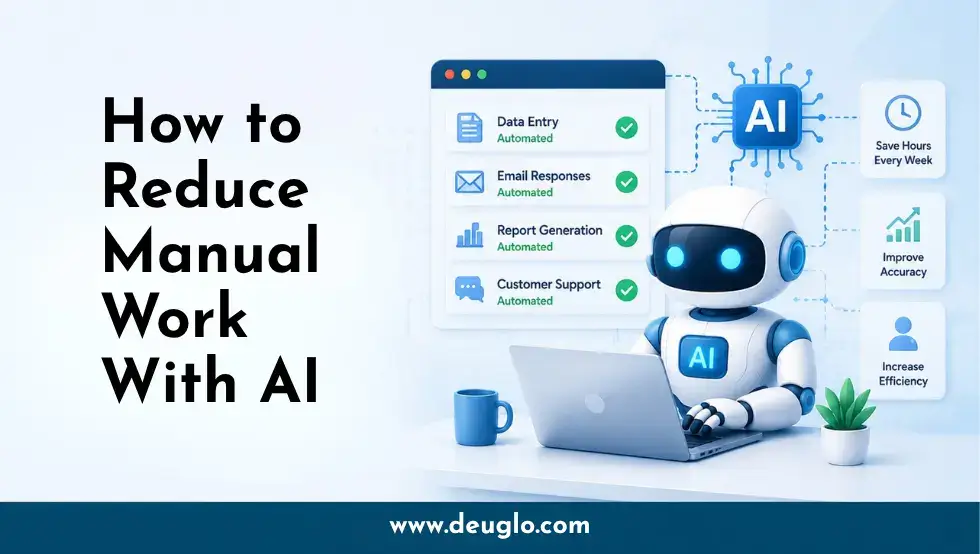
Businesses can reduce manual work with AI by automating repetitive processes, improving information access, reducing operational delays, and helping teams focus on higher-value activities.
AI adoption is no longer only about speed—it is increasingly about improving decision-making, reducing friction, and creating better business experiences.
At DEUGLO, AI discussions often start with identifying repetitive work rather than replacing existing workflows.
Why Manual Work Slows Business Growth
Manual processes often appear manageable at first.
But over time they create:
- delayed execution
- repetitive tasks
- inconsistent outputs
- slower customer response
- limited scalability
Many businesses do not realize how much time is spent moving information instead of creating value.
The goal is not removing people from processes—it is reducing unnecessary effort.
1. Identify Repetitive Tasks First
Before introducing AI, identify work that repeats frequently.
Examples:
✓ manual reporting
✓ content categorization
✓ lead qualification
✓ data entry
✓ document processing
✓ internal requests
AI creates the most value when applied to repetitive actions.
Start small.
Measure results.
2. Automate Information Flow
One of the biggest opportunities to reduce manual work with AI is reducing information movement.
Questions to ask:
- Does data move between tools manually?
- Are teams repeating updates?
- Are reports created manually?
AI-supported workflows can reduce these operational delays.
Less movement often means faster execution.
3. Improve Decision Support
Teams frequently spend time searching for information.
AI can support:
- summarization
- knowledge retrieval
- recommendations
- prioritization
- internal assistance
Good implementation helps people make decisions faster.
The goal should not be full automation.
The goal should be better execution.
4. Reduce Operational Bottlenecks
Some business delays happen because work depends on manual approvals and repetitive actions.
Review areas like:
✓ customer support
✓ onboarding
✓ internal operations
✓ reporting
✓ scheduling
Reducing bottlenecks often creates noticeable efficiency improvements.
5. Build AI Around Existing Processes
A common mistake is redesigning everything.
Instead:
Understand current workflows.
Then improve:
- speed
- consistency
- accessibility
- visibility
At DEUGLO, AI planning usually focuses on improving existing business operations before introducing larger transformation projects.
6. Focus on Human + AI Collaboration
Businesses often assume AI means removing manual involvement.
In practice:
Strong systems combine:
Human strengths:
- judgment
- communication
- creativity
AI strengths:
- repetition
- organization
- analysis
The best outcomes usually come from collaboration.
7. Measure Time Saved, Not Features
Success should not be measured by AI adoption alone.
Track:
- hours saved
- response time
- process completion
- operational efficiency
- customer outcomes
Small improvements often compound over time.
If manual work is slowing delivery or creating operational friction, reviewing workflow opportunities may become a practical next step.
Signs Your Business Has Too Much Manual Work
Watch for:
✕ duplicated tasks
✕ repeated approvals
✕ delayed reporting
✕ excessive spreadsheets
✕ operational bottlenecks
✕ inconsistent outputs
These are often indicators that processes need improvement.
Frequently Asked Questions
How can AI reduce manual work?
AI reduces repetitive activities by supporting automation, organization, and information access.
Is AI only useful for large businesses?
No. Smaller businesses often benefit by reducing repetitive operational tasks.
Does AI replace employees?
AI typically supports teams rather than replacing them.
What tasks should businesses automate first?
Start with repetitive, measurable, and operationally expensive tasks.
How long does AI implementation take?
It depends on complexity, process readiness, and business goals.
Conclusion
Businesses that successfully reduce manual work with AI usually focus on improving processes rather than increasing technology.
To reduce manual work with AI, prioritize repetitive tasks, workflow efficiency, and practical improvements that support teams.
At DEUGLO, we believe effective AI implementation should make work clearer, faster, and easier to manage—not more complicated.
If your business is evaluating where time is being lost, reviewing current workflows may reveal practical opportunities to improve efficiency and reduce operational effort.
Explore opportunities at www.deuglo.com