
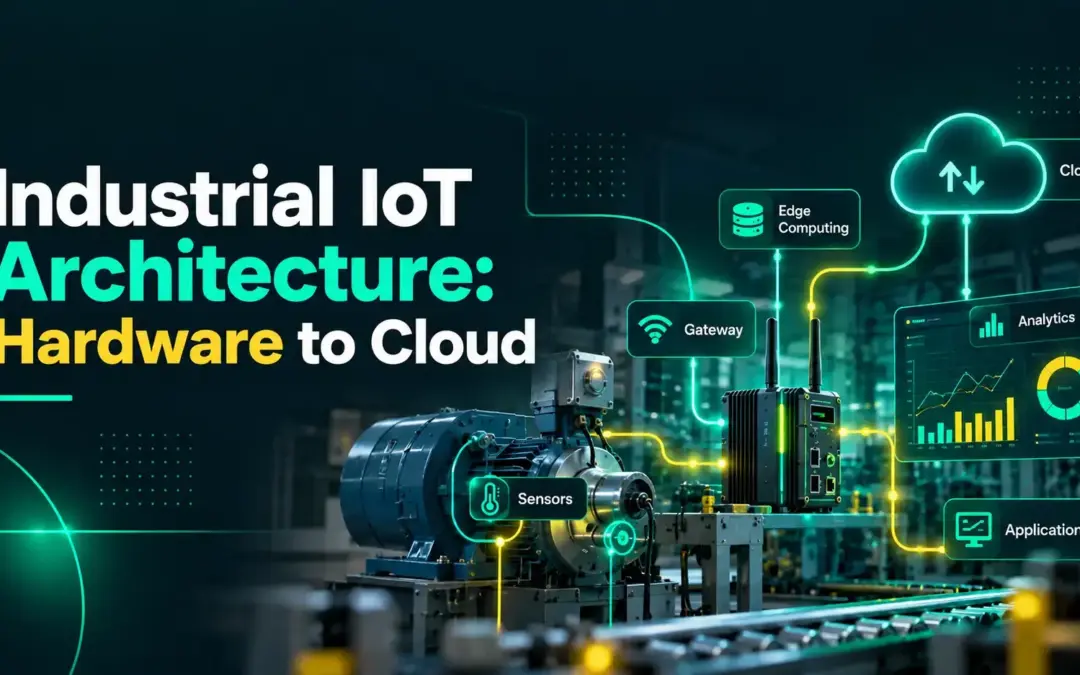
An industrial IoT project can involve hundreds or thousands of data points across machines, sensors, production systems and facilities.
But connecting everything to the internet is not an architecture.
A reliable Industrial IoT Architecture needs to define how data moves from physical equipment to processing systems, applications and the people who use the information.
A typical flow might look like:
Machine → Sensor → Gateway → Edge → Network → IoT Platform → Analytics → Application
The actual architecture can be simpler or considerably more complex depending on the industrial environment, data volume, latency requirements, security controls and existing systems.
What Is Industrial IoT Architecture?
Industrial IoT Architecture is the structure that defines how industrial devices, sensors, networks, computing resources, software platforms and business applications work together.
It provides a framework for moving data from the physical environment into systems where it can be analyzed and used.
A well-designed architecture considers more than connectivity.
It must also address:
- Data collection
- Device management
- Connectivity
- Processing
- Storage
- Security
- Integration
- Analytics
- Monitoring
- Scalability
The architecture should ultimately support a clear operational objective.
The Main Layers of an IIoT Architecture
There is no single architecture that fits every industrial application.
However, most IIoT architecture designs contain several logical layers.
Physical Equipment and Sensors
The physical layer is where industrial data originates.
Machines and sensors may provide information about:
- Temperature
- Pressure
- Vibration
- Flow
- Speed
- Energy consumption
- Position
- Machine status
- Production conditions
The choice of sensors depends on what the organization actually needs to measure.
Collecting unnecessary data increases complexity without necessarily creating additional value.
Edge Devices
Edge computing brings processing closer to the equipment generating the data.
An edge device or industrial computer can receive sensor data, perform local processing and communicate selected information to higher-level systems.
This can be useful when an application needs:
- Low-latency processing
- Local decision-making
- Reduced bandwidth consumption
- Continued operation during connectivity interruptions
- Local filtering or aggregation
For example, an edge system may process high-frequency machine readings locally and send summarized information to a cloud platform.
IoT Gateways
An IoT gateway can act as an intermediary between industrial equipment and modern IoT platforms.
This becomes particularly useful when a facility contains machines using different communication methods or legacy interfaces.
A gateway can help collect and translate information before sending it to another system.
The exact role depends on the equipment and protocols involved.
Connectivity Layer
The connectivity layer moves data between devices, edge systems and applications.
Possible technologies include:
- Industrial Ethernet
- Wi-Fi
- Cellular connectivity
- Field communication protocols
- Wired serial communication
- Other industrial networking technologies
The correct choice depends on factors such as distance, reliability, environment, bandwidth and latency.
There is no universal “best” industrial connectivity option.
IoT Platform and Data Management
Once information leaves the equipment environment, it needs to be managed.
An IoT platform can provide capabilities such as:
- Device registration
- Device monitoring
- Data ingestion
- Data storage
- Rules
- Alerts
- Application interfaces
- Data visualization
- Integration
The platform may be cloud-based, deployed locally or designed as a hybrid environment.
Architecture decisions should be driven by operational requirements rather than automatically choosing cloud or on-premises infrastructure.
Cloud IoT Architecture
Cloud platforms can provide scalable computing and storage for industrial applications.
They can be useful when organizations need to aggregate data across:
- Multiple production lines
- Several facilities
- Remote assets
- Large device populations
Cloud systems can also make it easier to connect IoT data with analytics, business intelligence and other digital services.
However, sending every piece of industrial data directly to the cloud is not always necessary.
This is where edge and cloud architectures often work together.
Edge + Cloud
A practical architecture may look like:
Sensors → Edge → Cloud → Analytics → Business Application
The edge handles time-sensitive or local processing.
The cloud handles broader aggregation, storage, analytics and centralized access where appropriate.
This hybrid model can balance operational requirements with centralized data capabilities.
Industrial IoT Data Flow
Understanding data flow is essential when designing an Industrial IoT system.
A simplified example:
- Sensor collects data
A machine sensor measures vibration.
- Edge device receives the reading
The edge system filters or processes the measurement.
- Network transports relevant data
Selected information moves through the industrial network.
- IoT platform stores and manages it
The platform associates the data with the relevant machine and time.
- Analytics identifies patterns
Historical and current data can be analyzed.
- Application presents the result
A dashboard displays machine condition information.
- Team takes action
Maintenance staff investigate the situation and determine the appropriate response.
This final step is important.
Technology creates value when the information reaches the people or systems capable of acting on it.
Industrial IoT Architecture and Existing Systems
Industrial environments rarely start from zero.
A new IIoT system may need to interact with existing:
- SCADA systems
- MES platforms
- ERP systems
- Maintenance software
- Quality systems
- Databases
- Business intelligence platforms
This makes IoT integration a major architecture consideration.
SCADA Integration
SCADA systems may already collect operational information.
An IIoT architecture can potentially extend that information to additional applications and analytics environments.
MES Integration
Manufacturing execution systems provide production-related information.
Connecting machine data with MES information can provide more useful production context.
ERP Integration
ERP systems contain business-level information such as inventory, purchasing and operations.
Connecting relevant industrial data with ERP systems can help bridge operational and business processes.
The exact integration approach depends on the systems already in place.
Security in Industrial IoT Architecture
Connecting industrial equipment introduces additional digital communication paths.
Security should therefore be considered from the beginning rather than added after deployment.
Device Security
Devices and gateways should have appropriate authentication, access controls and secure configuration.
Network Segmentation
Industrial networks can be segmented to limit unnecessary communication between systems.
Access Management
Only authorized users and systems should have access to relevant devices and information.
Data Protection
Data should be protected appropriately while being transmitted and stored.
Monitoring
Security and operational monitoring can help identify unusual behaviour and support incident investigation.
Industrial cybersecurity requirements vary significantly by environment, so architecture should be reviewed according to the organization’s risk profile and applicable requirements.
Designing for Scalability
An IIoT pilot may involve ten machines.
A production deployment may eventually involve thousands.
The architecture needs to account for this possibility.
Device Scalability
Can additional devices be registered without redesigning the system?
Data Scalability
Can the platform handle increasing data volumes?
Network Scalability
Can connectivity support additional devices and locations?
Application Scalability
Can dashboards and APIs continue to serve users as the system expands?
Operational Scalability
Can teams manage devices, updates and monitoring without excessive manual work?
Scalability should be considered before the pilot becomes a production dependency.
A Practical Industrial IoT Architecture Example
Consider a manufacturing facility monitoring critical motors.
The architecture could use:
Vibration sensors → Edge gateway → Industrial network → IoT platform → Analytics → Maintenance dashboard
The sensors collect vibration measurements.
The edge gateway can filter and process incoming readings.
Relevant information is transmitted to the IoT platform.
Analytics can compare current measurements with historical patterns.
The dashboard can then provide maintenance teams with machine-level information.
If the organization operates several facilities, the architecture could extend to:
Multiple plants → Centralized platform → Cross-site analytics
This provides a path from a focused use case to broader deployment.
How to Choose Between Edge, Cloud and On-Premises
The question should not be:
“Should we use cloud?”
A better question is:
“Where should each part of the workload run?”
Use Edge Processing When
Local processing, low latency or reduced data transmission is important.
Use Cloud When
Centralized storage, cross-site analytics or scalable computing is valuable.
Use On-Premises Systems When
Operational, regulatory, infrastructure or integration requirements make local deployment appropriate.
Use Hybrid Architecture When
Different workloads have different requirements.
For many industrial environments, hybrid architecture can provide a practical balance.
Common Industrial IoT Architecture Mistakes
Connecting Everything First
A large number of connected devices does not automatically create business value.
Start with the operational problem.
Ignoring Legacy Systems
Existing equipment and software often form a significant part of the environment.
Architecture should account for them from the beginning.
Sending All Data to the Cloud
Not every measurement needs to travel to centralized infrastructure.
Local processing can sometimes reduce unnecessary data movement.
Designing Without Security
Security should be part of the architecture rather than a later addition.
Building a Pilot That Cannot Scale
A proof of concept may work with a few devices but become difficult to manage at production scale.
Ignoring Data Context
Machine data without information about the asset, timestamp, operating condition or production context may have limited analytical value.
How Deuglo Can Help With Industrial IoT Architecture
Deuglo can help businesses plan and develop Industrial IoT Architecture across connected devices, edge systems, IoT platforms, applications and analytics.
The work can include IoT development, device connectivity, data flows, dashboards, system integration and automation.
Architecture decisions should be based on the equipment environment, operational requirements, security considerations, data volume and long-term deployment plans.
The objective is not simply to connect more machines.
It is to create an architecture that turns industrial data into information that people and systems can use.
Frequently Asked Questions
What is Industrial IoT Architecture?
It defines how industrial devices, connectivity, computing, platforms and applications work together to collect and use operational data.
What are the main layers of IoT architecture?
Typical layers include devices, sensors, edge systems, connectivity, platforms, analytics and applications.
What is an IoT gateway?
An IoT gateway connects industrial devices and communication systems with higher-level IoT platforms or networks.
Why is edge computing important in IoT?
Edge computing can process data closer to machines when local processing, low latency or reduced bandwidth use is important.
Does Industrial IoT require cloud computing?
No, industrial systems can use cloud, on-premises, edge or hybrid architectures.
Can IoT connect legacy machines?
Yes, suitable gateways, sensors and interfaces can sometimes connect older industrial equipment.
How does IoT integrate with ERP and MES?
IIoT can exchange relevant operational data with ERP, MES and other enterprise systems through appropriate integration methods.
Is Industrial IoT architecture scalable?
It can be designed for scalability across devices, data volumes, applications and facilities.
How important is cybersecurity in IoT?
Cybersecurity is a fundamental architecture consideration because connected industrial systems create additional digital access points.
How do you choose an IoT architecture?
Choose the architecture based on operational goals, equipment, data, latency, connectivity, security, integration and deployment requirements.
Can Deuglo help design IoT architecture?
Yes, Deuglo can support IoT architecture planning, development, integration, applications and industrial automation requirements.
Planning an Industrial IoT System?
Connecting industrial equipment is only the first step; the architecture determines how effectively that data can move, scale and support decisions.
Deuglo can help design an IoT architecture that connects hardware, edge processing, platforms, analytics and business systems around your operational requirements.
CTA: Discuss Your IoT Architecture