
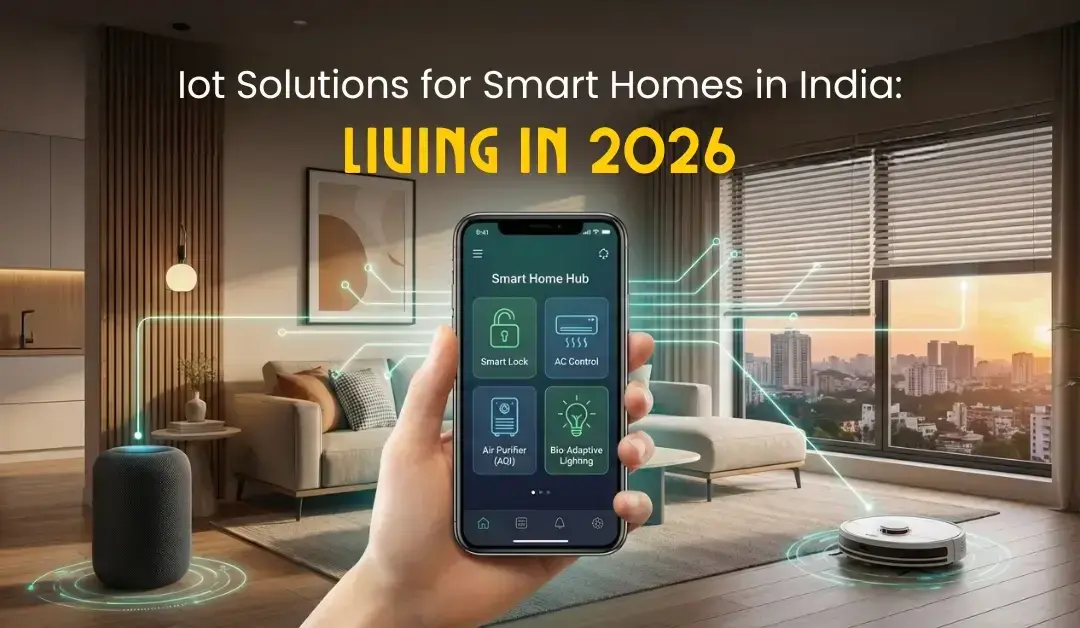
Imagine this: You are stuck in traffic on the Outer Ring Road in Bangalore or the DND Flyway in Noida. It’s 42°C outside. You are stressed. But then, you tap a single button on your phone.
By the time you reach your door, the AC has already cooled your living room to 24°C, the geyser is ready for a shower, and the lights have dimmed to a relaxing warm white.
This isn’t a sci-fi movie; this is the standard Indian home in 2026.
IoT Solutions in India have moved beyond fancy gadgets for the rich. They are now practical necessities for safety, energy saving, and comfort. In this guide, we explore how the Internet of Things (IoT) is redefining the Indian household this year.
1. Security First: The “Digital Watchman”
In cities like Delhi and Gurgaon, security is the #1 driver for smart home adoption.
- Smart Locks: No more hiding keys under the doormat. In 2026, you unlock your door with a fingerprint or a temporary OTP generated for your maid or cook.
- Video Doorbells: See who is at the door from your office desk. Two-way audio allows you to tell the delivery guy, “Leave the package at the gate,” without opening the door.
- Intrusion Alerts: If a window opens while you are on vacation, your phone screams an alarm instantly, and you can alert the local security guard.
2. Energy Efficiency: Lowering the Bills
With electricity tariffs rising across India, IoT is your wallet’s best friend.
- Smart AC Controllers: Did you forget to turn off the AC? Geofencing detects when you leave the house and turns it off automatically. This alone saves Indian households up to 30% on summer electricity bills.
- Smart Plugs: Turn your heavy appliances (Geysers, Motors, Microwaves) into smart devices. Schedule your water pump to run only during non-peak hours.
3. The Health-Conscious Home
Given the pollution levels in North India (Delhi NCR) and water quality issues in metro cities, IoT is playing a massive role in health.
- Smart Air Purifiers: These devices don’t just run blindly. They constantly monitor AQI (Air Quality Index) inside your room. If the AQI spikes (say, during Diwali or crop burning season), the purifier kicks into “High Mode” automatically.
- Smart Water Monitoring: IoT sensors in your overhead tank now check the TDS levels and alert you on your phone when your RO filter needs changing, ensuring you never drink unsafe water.
4. Lighting that Suits Your Mood (and Circadian Rhythm)
Tube lights are boring.
- Bio-Adaptive Lighting: Your bedroom lights mimic the sun. They are bright white in the morning to wake you up and slowly turn sunset-orange by 10 PM to help you sleep better.
- Party & Movie Modes: One voice command—“Alexa, Movie Time”—and the blinds close, the lights turn off, and the LED strips behind your TV glow soft blue.
5. Overcoming the “Connectivity Chaos”
The biggest challenge with IoT Solutions in India used to be that the bulb didn’t talk to the fan, and the fan didn’t talk to the AC.
- The Matter Protocol: In 2026, the “Matter” standard has fixed this. You can buy a bulb from Brand A and a switch from Brand B, and they work together seamlessly on a single app.
How Deuglo Builds the Brain of the Smart Home
Buying devices is easy. Making them work together in a custom ecosystem is hard. That’s where Deuglo comes in.
We don’t sell bulbs; we build the software infrastructure that makes smart homes smart.
- Custom IoT Dashboards: For real estate developers in Noida and Bangalore, we build branded apps that control the entire apartment complex (Gate security, Club booking, Apartment automation) in one place.
- App Integration: We help hardware startups integrate their devices with Alexa, Google Home, and Apple HomeKit.
Final Thought: It’s Not About Laziness
Critics say smart homes make us lazy. We say they make us efficient. When you don’t have to worry about whether you locked the door or turned off the geyser, you free up mental space for things that actually matter.
Welcome to the home of 2026.